
Pennsylvania’s data problems leave six federal child-welfare measures unavailable
DHS tells RTK Media that separate foster-care and maltreatment systems cannot reliably match individuals. Its response outlines a future solution but leaves the timetable and a separate reporting defect unexplained.
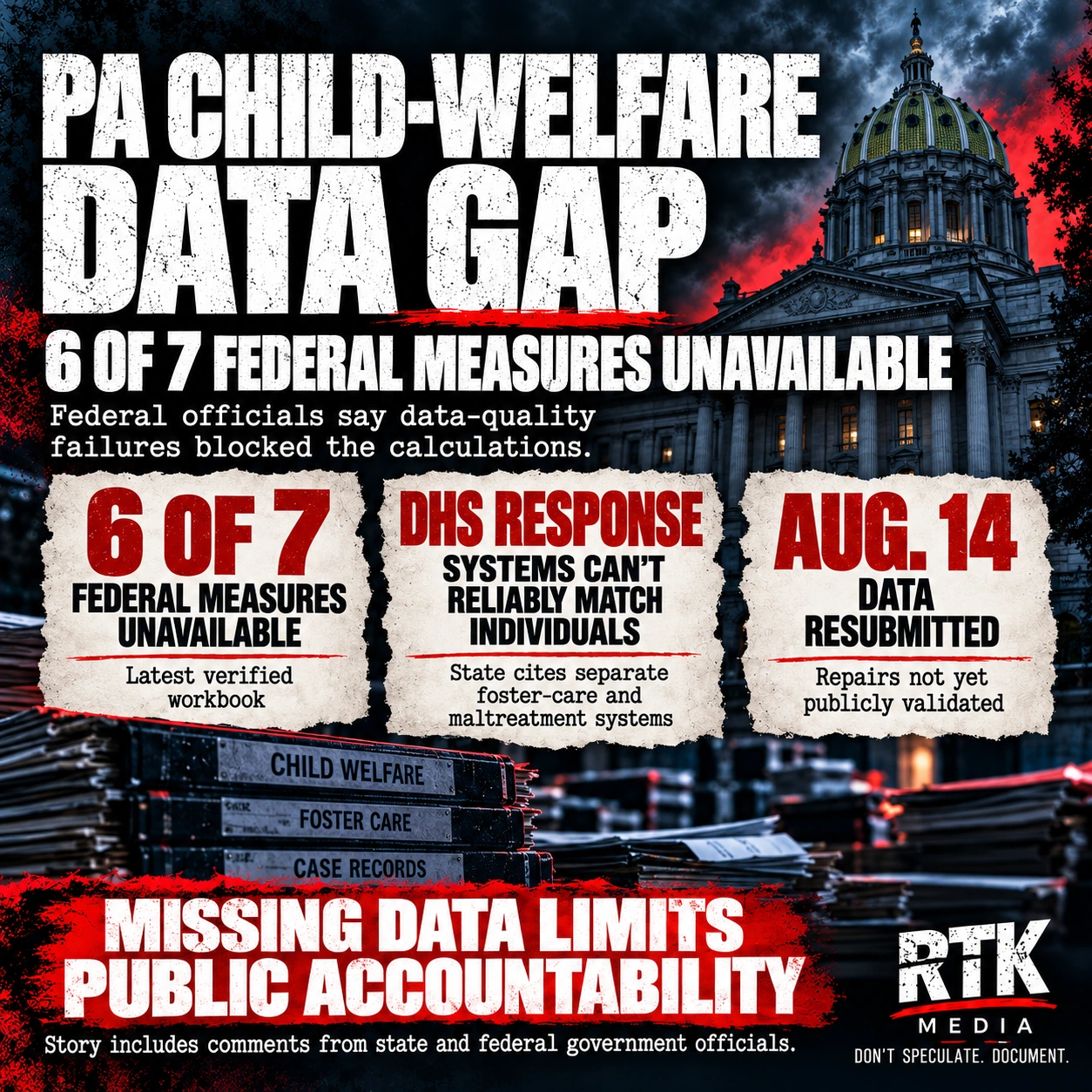
PENNSYLVANIA — Pennsylvania’s Department of Human Services has acknowledged that its foster-care and child-maltreatment data are maintained in separate systems that cannot reliably match individuals, providing a substantive state explanation for part of the reporting problem examined in an RTK Media investigation.
“The two systems do not have a reliable way to match individuals between the two separate systems,” DHS Press Secretary Brandon Cwalina wrote in an October 23 response to RTK Media. [1]
Federal officials previously confirmed that Pennsylvania’s data-quality problems excluded it from six statewide child-welfare indicators. The state’s new response describes a planned improvement, but does not establish that the excluded measurements have been restored. [1][2]
The distinction matters: missing calculations are not findings that Pennsylvania performed poorly. Nor does a failure to match records for reporting establish that caseworkers lack individual case files or that all child-welfare oversight has stopped.
What the federal workbook shows
The federal Child and Family Services Reviews workbook covers August 2026 data profiles and submissions received through June 24, 2026. Pennsylvania is excluded from the latest calculations for:
- Maltreatment in foster care.
- Permanency within 12 months for children entering foster care.
- Permanency within 12 months for children already in care 12–23 months.
- Permanency within 12 months for children already in care 24 months or longer.
- Reentry to foster care within 12 months.
- Placement stability. [3]
These measures address children’s safety during foster care, timely permanent placements, returns to care, and placement changes. Federal guidance describes them as tools for evaluating performance and informing improvement efforts. [4]
The seventh indicator, recurrence of maltreatment, remained measurable and rated better than national performance. [3]
DHS describes separate systems and a future fix
Cwalina said child-welfare data are maintained in individual county systems. The state collects foster-care information from counties to meet federal reporting requirements, but maintains it separately from the system containing child-maltreatment data.
The department said its planned child-welfare case-management system would address the difficulty connecting records.
“Plans are in place to resolve these issues and assure the maintenance of a single person record within the future child welfare case management system,” Cwalina wrote. [1]
That is a commitment to a future approach, not an announcement that the problem has been fixed. The statement did not give an implementation date, identify completed validation milestones, or explain whether an interim repair could restore the affected calculations before the new system is operational. It also did not identify a particular county or vendor as responsible for the reporting defects. [1]
A separate data-quality failure excluded all six measures
The state’s explanation addresses record matching. Federal officials, however, identified a separate issue sufficient to exclude Pennsylvania from all six indicators.
“The error check ‘Percentage of children on 1st removal’ alone disqualified Pennsylvania from six of the DQ statewide indicators,” the federal Administration for Children and Families’ Office of Communications wrote on October 16. “DQ” refers to data quality. [2]
Pennsylvania’s reported first-removal percentage rose from 80.4% in reporting period 2023A to 98.1% in 2023B. It remained above the 95% data-quality limit through 2026A. Those are flagged values in submitted records, not verified changes in children’s actual removal histories. [3]
DHS’s October 23 statement did not explain that change or identify the corrections needed to resolve the first-removal issue. The correspondence therefore does not establish that fixing the connection between the two systems would, by itself, restore every excluded measure. [1][2]
Why matching records matters
The maltreatment-in-foster-care calculation uses information from two federal datasets: the Adoption and Foster Care Analysis and Reporting System, or AFCARS, and the National Child Abuse and Neglect Data System, or NCANDS. Federal guidance calls for matching records using AFCARS identifiers. [5]
ACF told RTK Media that Pennsylvania’s federal fiscal year 2025 NCANDS child file contained no AFCARS identifiers in the designated field. That prevented the required matching and independently disqualified the foster-care-maltreatment calculation. [2]
DHS’s acknowledgment of unreliable matching provides state context for the linkage problem identified by federal officials. The state’s statement does not, however, say that the missing identifiers have now been supplied or that the federal matching checks have been passed. [1][2]
ACF also questioned the identifiers Pennsylvania supplied in 2022–2024. Based on a conversation with the state, the agency said those were not actually AFCARS identifiers and that the historical checks “should probably” have reflected failures. That qualified explanation is not a formally corrected historical series. [2]
The recurrence measure requires a separate explanation
DHS’s statement acknowledged data-quality issues associated with both “Maltreatment in Care” and “Recurrence of Maltreatment.” [1]
ACF’s explanation makes an important distinction. The federal agency said recurrence uses NCANDS data alone and was not affected by the particular AFCARS submission and cross-system linkage defects it described. ACF also said each indicator should be interpreted independently. [2]
DHS did not specify which reporting periods its reference to recurrence concerned, identify a separate recurrence defect, or provide a revised recurrence result. The available statements do not resolve whether the department was describing a different problem, a different period, or a broader data-quality concern. [1][2]
The state’s wording therefore does not, by itself, establish that the published recurrence result is invalid. Recurrence should not be counted among the six excluded indicators. [2][3]
Earlier warnings and the state’s published plan
ACF said the deficiencies would have appeared in feedback Pennsylvania received when uploading its files and would have been reflected in the state’s data profiles starting in 2024. That identifies earlier opportunities to recognize the problems, but does not establish when individual DHS leaders reviewed the feedback or what instructions they issued. [2]
An August 7, 2025 DHS bulletin separately acknowledged significant AFCARS data-quality challenges at both the state and county levels. It said the problems limited accurate reporting about children in care and had led to federal noncompliance for all AFCARS Final Rule submissions made to that point. [6]
The bulletin directed counties to improve data entry, review and correct errors, verify identifying information, and coordinate with system owners and the state’s AFCARS team. Those instructions document corrective efforts, not proof of their completion. [6]
Pennsylvania’s 2027 Annual Progress and Services Report describes an interim AFCARS solution intended to maintain federal-rule compliance, alongside plans for a permanent AFCARS component within a statewide child-welfare case-management system. It links that planned component to resolving data-quality concerns and enabling federal indicator calculations. [7]
The October 23 statement is consistent with that planned direction. Neither the statement nor the report establishes that the six calculations have been restored. [1][7]
August resubmission does not establish successful repair
ACF said Pennsylvania resubmitted AFCARS data covering federal fiscal year 2023 onward on August 14, 2026. Those submissions were not reflected in the most recent profile discussed in its October 16 response.
The agency explained that profiles are generated every six months, with quality checks run against the latest submissions. It said its AFCARS administrator meets regularly with Pennsylvania to prioritize improvements.
The federal response did not provide an exact next release date or confirm that the replacement submissions passed the relevant checks. DHS’s new statement did not supply that confirmation, specify which historical periods had been corrected, or report a completed repair to the NCANDS identifier problem. [1][2]
Resubmission is evidence of action. Restoration of the measurements requires evidence that the relevant defects have been resolved.
Who responded to RTK MEDIA
RTK Media sent technical and leadership questions to DHS representatives Brandon Cwalina and Ali Fogarty on October 15, copying the department’s press office on the technical inquiry. Fogarty acknowledged the requests and said DHS would coordinate them as one inquiry. RTK Media followed up on October 23, and Cwalina provided the statement quoted in this article that day. [1][8]
ACF’s Office of Communications provided its substantive written answers through HHS Public Affairs on October 16. A separate technical inquiry to ACF’s Dr. Cara Kelly had not received an individual response in the correspondence reviewed; ACF itself nevertheless supplied an official response. [2][8]
RTK Media also contacted Kelly Hoffman and Carolyn Myers at Pennsylvania Partnerships for Children. On October 19, Communications Manager Alexa Regan referred the questions to DHS, saying it was best positioned to address the state’s reporting and federal exclusions. The organization responded but did not answer the substantive questions about the missing measurements. [8][9]
Brian Bornman, contacted for the Pennsylvania Children and Youth Administrators association’s perspective on county reporting challenges, had not responded in the correspondence reviewed through October 23. [8]
What remains unanswered
DHS has now provided an on-record explanation of a systems limitation and its proposed long-term approach. The response does not explain the first-removal reporting change, establish which corrections have passed federal validation, or provide a date for restoring the missing calculations. It also does not identify validated alternative measures being used while those federal comparisons are unavailable. [1][2][8]
Funding consequences remain unresolved in the correspondence as well. Asked whether sanctions or funding consequences had actually been imposed, ACF described the indicators’ role in the broader review process without saying whether a consequence had been imposed in this instance. DHS’s new statement did not address that question. The responses establish neither that penalties occurred nor that none occurred. [1][2]
The missing indicators do not establish poor care or intentional concealment. They document a gap in these particular federal comparisons. Other oversight processes, including case reviews and stakeholder interviews, are separate from the statewide calculations. [4][10]
The accountability question is now more specific: when will Pennsylvania demonstrate that its planned improvements produce data that pass the relevant checks and restore the missing measures?
Reporting note
This version incorporates DHS’s October 23, 2026 statement and ACF’s October 16, 2026 answers. Correspondence was reviewed through October 23. ACF instructed RTK Media to identify the profile as August 2026 despite September wording on the workbook’s cover. [2][3]
RTK MEDIA LLC
Don’t Speculate. Document.
Sources
- [1] Pennsylvania DHS statement emailed to RTK Media by Brandon Cwalina, Press Secretary, October 23, 2026. Ali Fogarty was copied. The article quotes the statement, not the reporter’s questions in the email chain. Read the full DHS statement.
- [2] ACF Office of Communications written response to RTK Media, sent through HHS Public Affairs, October 16, 2026.
- [3] CFSR Round 4 Statewide Data Indicators Workbook, August 2026 profile; pages 2, 11, 22, and 44–45, with the individual indicator tables on pages 8–21:
https://www.cfsrportal.acf.hhs.gov/document/download/DRlGPn - [4] CFSR Information Portal, statewide data indicator overview:
https://www.cfsrportal.acf.hhs.gov/resources/round-4-resources/cfsr-round-4-statewide-data-indicators - [5] CFSR Round 4 Statewide Data Indicators Data Dictionary, page 1:
https://www.cfsrportal.acf.hhs.gov/document/download/NxyBrq - [6] Pennsylvania DHS/OCYF Bulletin 3140-25-03, August 7, 2025, pages 17–18:
https://www.pa.gov/content/dam/copapwp-pagov/en/dhs/documents/docs/publications/documents/forms-and-pubs-ocyf/ocyf-bulletin-3140-25-03-needs-based-plan-and-budget-2026-2027.pdf - [7] Pennsylvania DHS, 2027 Annual Progress and Services Report, page 1:
https://www.pa.gov/content/dam/copapwp-pagov/en/dhs/documents/docs/publications/documents/child-youth-and-family-service-plan/2027-annual-progress-and-services-report.pdf - [8] RTK Media’s October 15 requests for comment, October 23 DHS follow-up, and related correspondence reviewed through October 23, 2026.
- [9] Alexa Regan, Communications Manager, Pennsylvania Partnerships for Children, email to RTK Media, October 19, 2026.
- [10] Pennsylvania DHS, Child, Youth, and Family Services Plan page, description of the review process:
https://www.pa.gov/agencies/dhs/departments-offices/ocyf-info/child-youth-family-service-plan